05/2025 Directional sign from 1945

Object of the Month – May
The featured object for May is a directional sign bearing the symbols of the number 1, a white eight-pointed star, and a red crescent. It was used to guide volunteers from the 1st Turkestan Labor Battalion during their relocation in May 1945. The sign originates from Železný Brod, where the battalion was stationed at the time, and it pointed the way for passing military units.
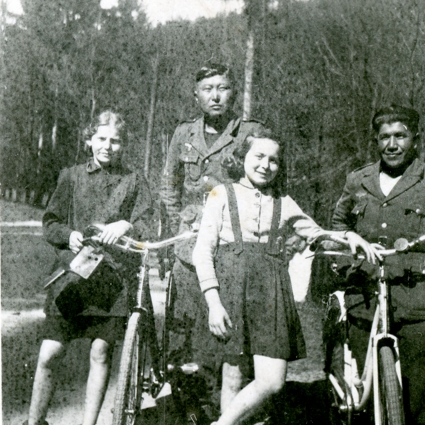
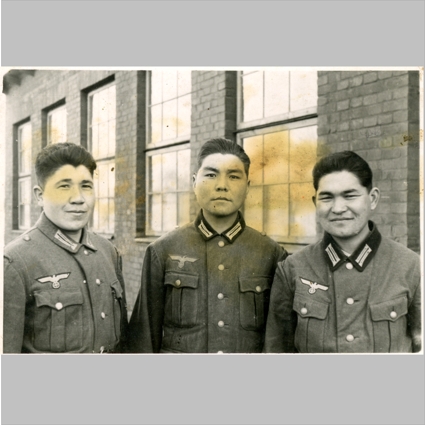
The 1st Turkestan Labor Battalion was established in February 1943 in occupied Poland and was primarily composed of former Soviet soldiers captured by German forces. The unit was tasked with building military facilities and defensive lines. In the spring of 1945, as German troops retreated from the advancing Red Army, the battalion was deployed in the Sudetenland, where it continued its construction efforts. Accounts of the battalion’s presence in Železný Brod and surrounding villages come mainly from eyewitness testimonies and local chronicles.
Bohuslav Kacálek recalls: "In Železný Brod, starting around January 20, 1945, all men were required to help build trenches. These were planned not only along the roads leading into the town, but also within the town itself. The three most important ones were located at both ends of the bridge and beneath the bell tower, between the rock and the Jizera River.
These trenches were constructed from massive tree trunks, partially buried in the ground and fastened together at the top, much like a timber-framed house. The interiors were filled with stones. They were always built in pairs so that any passing vehicle had to zigzag through them. Loopholes were also included, behind which defenders could take cover and fire.
Other trenches and fortifications were built in various locations both on the approaches to the town and within its limits. These were also constructed by prisoners—said to be Turkestanis. Apparently, the Germans had enough trust in them, as in many places there was just a single German soldier guarding around thirty prisoners.
As children, we noticed that from time to time, one of the Turkestanis would begin to sing, and then they would all kneel in the same direction and touch their foreheads to the ground. Only much later did I realize they were probably Muslims. The German guard paid no attention to their prayers whatsoever."
Teacher František Sochor, in his article describing the events of May 1945, writes:“On May 3, 1945, the disarmament of guard soldiers from the Turkestan labor squads in Těpeře and Jirkov was reported.”He further notes that on May 5:“A report arrived from Pelechov about the passage of troops who did not wish to fight but only to return home. It was later confirmed that these were Turkestanis, marching in a long column with several wagons toward Malá Skála.”
The town chronicle of Vysoké nad Jizerou records:“On March 14, 1945, a labor battalion consisting of 300 men arrived in Vysoké nad Jizerou. The unit was made up mainly of soldiers from the Caucasus, particularly Armenians and Georgians. Vysoké was to be turned into a stronghold, with its entrances closed off and a deep anti-tank ditch dug around it. Residents of Vysoké and neighboring villages were also required to participate in the construction of these fortifications.”
Similarly, the chronicle of the town of Semily states:“A labor detachment of former Soviet prisoners of war, numbering 200 men from Turkestan in Central Asia, began work on an anti-tank ditch (Panzergraben) above the town reservoir in Semily near the site known as Čtrnáct pomocníků. The ditch measured 6 meters wide, 3 meters deep, and stretched approximately 400–500 meters. It ran through meadows on both sides of the road near the Manor Forest and across fields toward the Propadliště woods. At the same time, an anti-tank barrier (Panzersperre) was being constructed on the road, with timber sourced from the forest of the deanery—around 30 cubic meters—also in Propadliště.”
The later fate of this battalion remains unknown. Should any of its members have returned to the Soviet Union after the war, they likely faced a grim future. Up to 80 % of all former forced laborers who went back home were sentenced to labor camps. Many were exiled from their communities or forced into hard manual labor. The Soviet regime considered them politically unreliable and treated them accordingly.