3/2025 Sheet Music
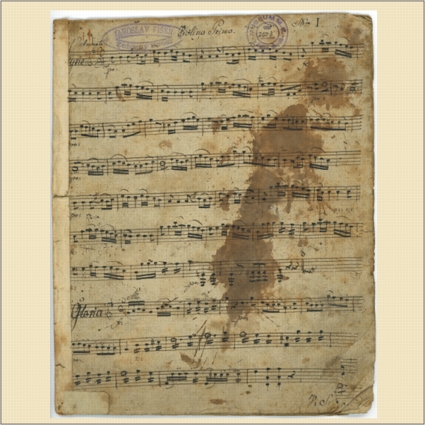
In their daily work, curators often encounter intriguing challenges. Occasionally, they come across an object that requires specialized knowledge beyond their expertise. Such is the case with March’s Object of the Month – a manuscript of sheet music. But how should we approach it?
Unfortunately, no one in the museum team has a musical background to assist with its identification. This means we must rely on our collective reasoning and try to gather as much information as possible—not only about the manuscript’s content but also its origins. Our first clues come from two ownership stamps. A historical museum stamp with a catalog number directs us to an old accession book, where we discover that the sheet music was donated to the museum by Jaroslav Fišer. This matches the second ownership stamp found on the document.
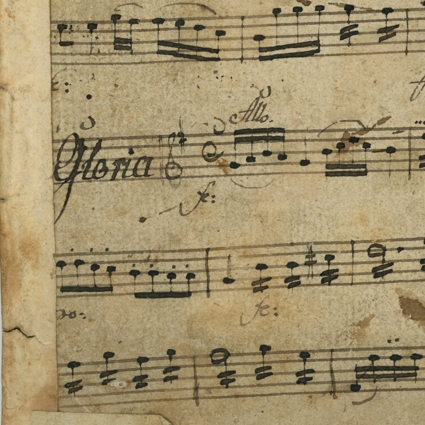
Unfortunately, the book does not reveal the composition’s title. However, the manuscript includes the names of individual sections, suggesting that it was written for liturgical purposes. The heading Violino primo indicates that it is a notation for the first violin. Without deeper knowledge of music and its history, identifying the composition proves challenging. Nevertheless, this document offers valuable historical connections, particularly to the Fišer family—one of the wealthiest and most influential families in Železný Brod in the 19th century.
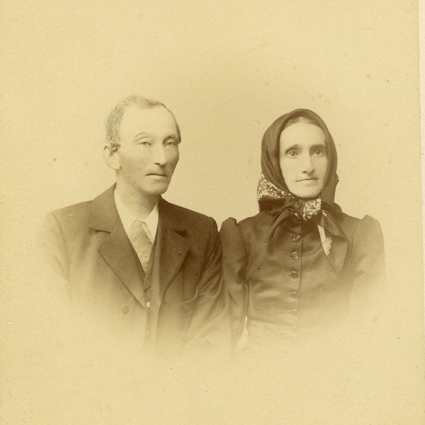
The family’s most notable member was Michal Antonín Fišer (1825–1897) a merchant, scribe, and musician. Many of his relics, as well as those of his father, Michael Ignác Fišer, a school preceptor, have been preserved in the museum. In addition to numerous musical notations, the collection includes unique musical instruments they played.
School preceptors of that era were not just educators; they were also key figures in preserving and passing on musical traditions. They led school choirs, played during church services, and often transcribed or composed music themselves. Sheet music was passed from musician to musician, from teacher to student, ensuring the survival of a region’s musical heritage across generations. This manuscript, therefore, is not just a record of a single composition—it is a testament to the broader tradition of music education and the sharing of musical knowledge in the past.