02/2026 A Dance Card in the Shape of a Knight’s Helmet
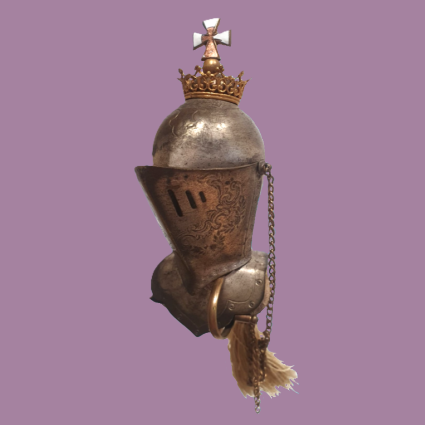
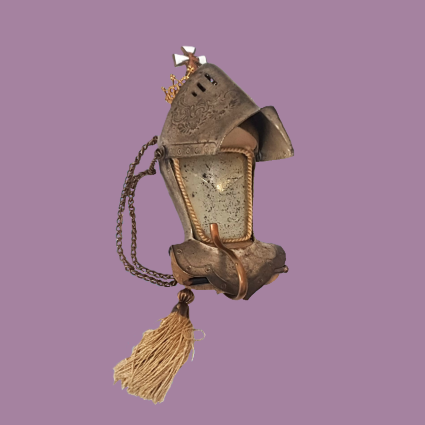
The ball season is in full swing, and for this reason, we have chosen a fascinating object closely connected with this period as the exhibit of the month – a dance card in the shape of a knight's helmet, originating from a prestigious Vienna ball held in 1887, whose distinguished guest included the heir to the Austro-Hungarian throne, Prince Rudolf.
History of Dance Cards
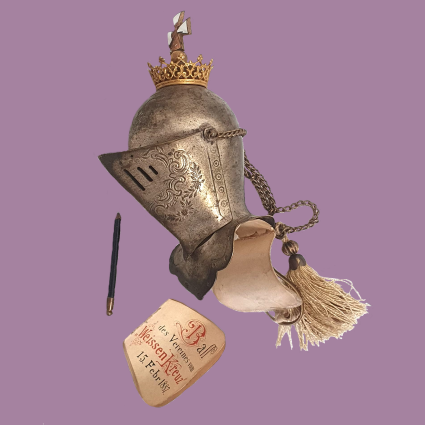
The history of dance cards dates back to the 19th century, when they were issued by ball organizers as part of the admission ticket. Every attendee received a dance card, which served as a sort of program – it contained information about the order of the individual dances performed at the ball, and included a small pencil that allowed each guest to note down their agreed-upon dance partner for each dance. Each dance card also featured a chain ending in a hook, which allowed ladies to attach the card to their handbag or keep it inside, while gentlemen would hang it, for example, through the buttonholes of their tailcoats.
The design of dance cards was highly diverse – ranging from simple cardboard fold-outs, to elaborately crafted booklets resembling miniature book bindings, and even to richly artistic compositions combining materials such as metal, textiles, feathers, etc., which often referenced the ball’s organizers in their design.
The Dance Card from Our Collections
The dance card in our collection dates from 1887, and the way it came to the museum remains shrouded in mystery. It is a miniature knight’s helmet, 11 cm in height, made of silver, with a gilded crown and a white enamel cross, fitted with a hinged visor behind which a small mirror is hidden.
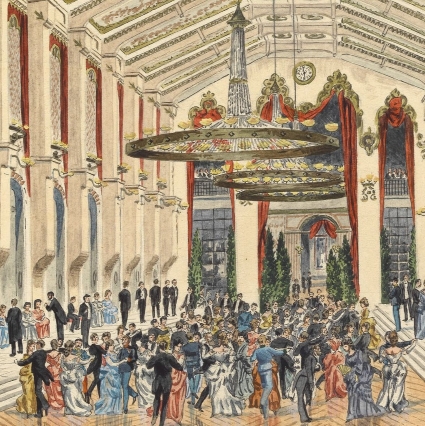
It was created for a ball organized by the Austrian Society of the White Cross, whose purpose was to care for members of the Austro-Hungarian army wounded in war during peacetime, primarily in sanatoria. The ball was held the same year at the Sofiensäle in Vienna and was attended by a significant portion of the aristocracy of the time; among the most distinguished guests was Crown Prince Rudolf, who was also a patron of the society. Also present were the brothers of Emperor Franz Joseph I – Archdukes Ludwig Viktor and Karl Ludwig – as well as Archdukes Rainer Ferdinand of Habsburg-Lorraine and Wilhelm Franz Karl of Austria-Teschen, alongside other members of the high aristocracy. The ball was also attended by prominent statesmen and military figures, as well as numerous high-ranking ladies from the circles of princesses, baronesses, and countesses.
The description of this prestigious ball was recorded in the Austrian newspaper Die Presse on 16 February 1887. The following excerpts illustrate not only the atmosphere and decoration of the hall but also the distinguished guests and the course of the dances:
"The greatest decorative feature was the stage, transformed into a tent made of the most precious fabrics, with a magnificent tapestry forming its backdrop. Above the tent rose a second tapestry of equally monumental proportions. On both the right and left sides of the tent, groups of exotic plants were arranged, reaching up to the balustrade draped in red velvet. The decoration was further complemented by numerous trophies, giving the entire wall of the hall a unified, harmoniously coordinated appearance, connecting to the side balconies. The walls were also covered with red velvet and damask and adorned with weapons and banners, forming a splendid gallery, beneath which hung a row of charming flower baskets. In the center of this gallery, tapestries framed by draperies hung on both sides, reaching down to the plants and flower arrangements on the ground floor. Above the main entrance rose a massive tapestry, flanked by abundant arrangements of weapons, banners, and armory."
"Crown Prince Rudolf, whose representational duties during this year’s carnival took place nearly every night, honored the ball with his presence for an hour. Also present were Archdukes Karl Ludwig, Ludwig Viktor, Wilhelm, and Rainer, Prince Philipp of Coburg, and Prince Gustav of Saxe-Weimar. Prominent statesmen and military figures also attended, including the Minister of Commerce, Marquis Olivier de Bacquehem, generals, chief physicians, and other high-ranking officers. From the theater were present the ladies Hohenfels, Sandrock, and Countess Hermine Albrecht Nyary."
"Crown Prince Rudolf, after briefly speaking with the ball’s patrons, was introduced through the court councilor to many members of the committee and later spoke with Marquis von Bacquehem, General Intendant Freiherr Josef Bezecny, and Baron Ringhoffer, owner of the Smíchov factory. At 11:00 p.m., the Crown Prince left the hall to attend a soirée at the English ambassador’s residence, held the same evening. Shortly after him, other members of the court and the ball’s patrons departed as well."
"Among the ladies present were, for example: Princess Metternich, in a narrow white satin skirt with three fur-trimmed borders, topped with tulle chiffon and a short sash, with a black velvet train adorned with black-and-white striped ribbons, and a bodice decorated with diamond buttons; Princess Montenuovo-Kinsky, in a lavish red velvet gown trimmed with red satin; Countess Irma von Taaffe, in a yellow-brown fur gown with a front panel of colorful floral Rococo brocade; Countess Emma Wilczek, in a brightly yellow damask gown with a richly decorated long train; Baroness Königswarter, in a blue-gray gown with a light blue front panel, on which rare lace pieces were tied into bows, with bodice and train made of chaudron velvet, decorated with lace and blue feathers; Baroness Drasche Wartinberg, in a white satin gown with a lace front panel; Baroness Stummer Tavarnok, in a yellow satin gown with wide flounces and garlands of roses."
"The original and distinctly martial character of the ball was further emphasized by the ladies’ gifts: a silver helmet with a gilded crown and a white enamel cross, behind the hinged visor of which was a small mirror."
"The cotillion, as expected, depicted white crosses. Sixteen ladies in blue gowns sat on sixteen chairs; four ladies in red gowns moved like red points in a radial pattern, while the remaining ladies in white gowns danced the ‘white cross.’"
“The dance dedications – the waltzes Desterreich in Lied und Wort by Eduard Seuffert, In Helm und Wehr by Karl Bellner, and the polka-mazurka Ritterdienste by Alfred Straßer – received enthusiastic applause.”