11/2025 The Martyrdom of Saints Peter and Paul by Johann Daniel Herz Sr.
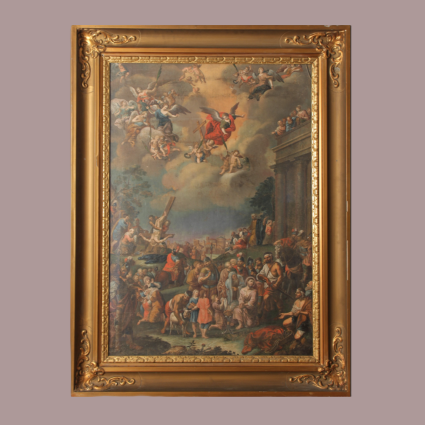
The exhibit of the month for November is a large-format hand-colored copperplate engraving depicting the martyrdom of Saints Peter and Paul, created by the prominent German draftsman, engraver, and publisher Johann Daniel Herz Sr. (1693–1745).
Iconography
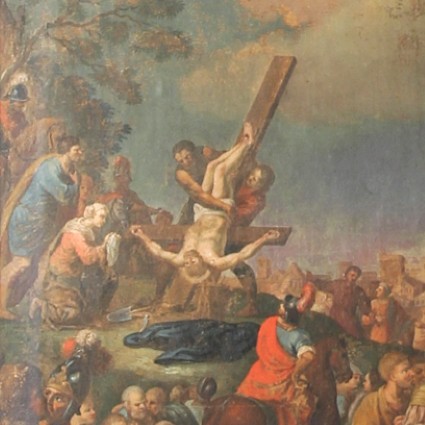
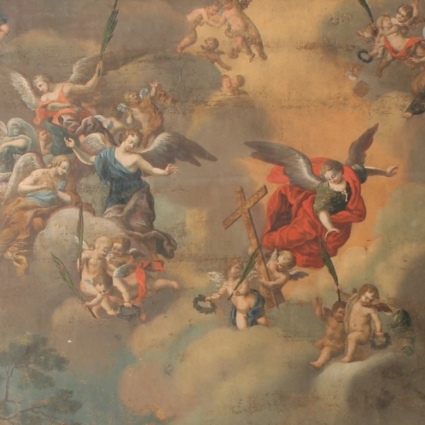
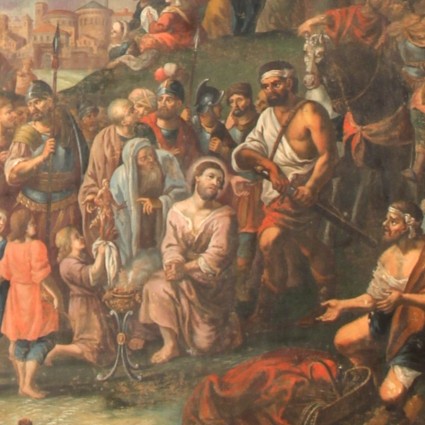
The work depicts the martyrdom of the apostles Peter and Paul, which took place in Rome in the first century AD during a period of intense persecution of Christians. Both executions are witnessed by a large gathering of onlookers, above whom angelic figures appear in the heavens. Saint Peter is shown at the moment of his crucifixion, which, according to legend, he underwent upside down because he did not consider himself worthy to die in the same manner as his Lord, Jesus Christ. Saint Paul is depicted kneeling, with an executioner standing behind him, sword in hand, ready to carry out the beheading. The sword subsequently became established in Christian iconography as his characteristic attribute.
About the author
Johann Daniel Herz was born on 20 September 1693 in Augsburg into the family of Daniel Herz, a cabinetmaker and silversmith. He possessed a remarkable and inventive artistic talent—engraving from his own drawings, though he primarily worked after the designs of other artists. He spent his entire life in Augsburg, where he operated his own publishing house, issuing etchings by important contemporaries such as Johann Evangelist Holzer and Carlo Carlone.
He was the author and co-author of numerous significant works. Among them is the large-format print View of Jerusalem with the Passion of Christ from around 1735, a copy of which is held in the collections of the Olomouc Museum of Art, as well as the allegorical frontispiece with a portrait of Empress Maria Theresa in the ceremonial volume documenting her coronation, The Three Descriptions of the Most Celebrated Entry of Maria Theresa into the Royal Cities of Prague (1743).
He also took part in creating allegorical engravings based on designs by the prominent Czech Baroque painter Václav Vavřinec Reiner for the celebrated Müller Map of Bohemia (1720). In addition, he collaborated on the multi-volume drawing manual intended for the instruction of art students, the Zeichenbuch (1732), which contains sixty plates featuring studies of heads, figures, and anatomical details.